
Articles
HCC student and faculty member write practical engineering lab manual
Jan 13, 2026
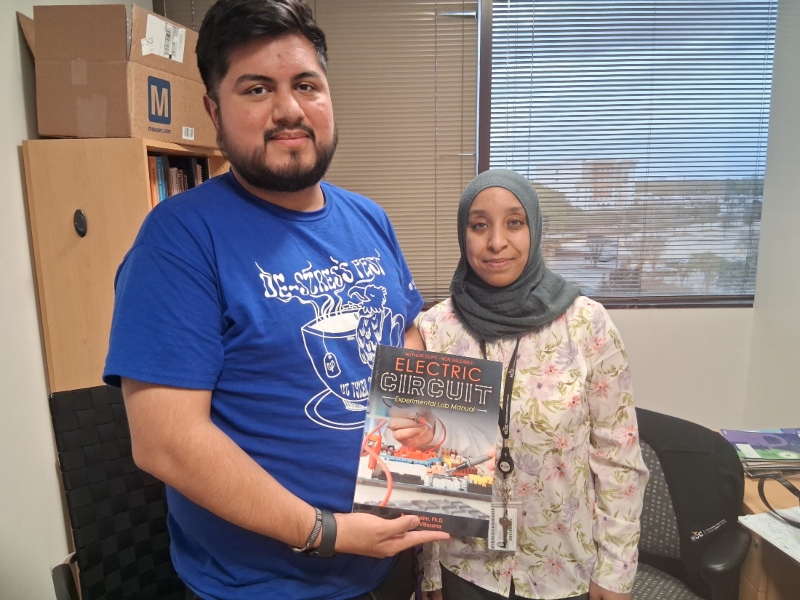
HCC student Hector Villasana and full-time faculty member Dr. Reem Salim display the experimental lab manual that they wrote.
One of the major hurdles for those wanting to jump into engineering is finding simple experiments accessible to beginners. Two people in HCC’s engineering department have sought to overcome this hurdle by creating a manual of fun lab experiments for novice learners.
Dr. Reem Salim, a full-time faculty member in HCC’s engineering department, and her colleague, Hector Villasana, a lab assistant at HCC, have written an experimental lab manual titled “Electric Circuits” that includes 31 practical lab exercises for engineering students.
The idea for the manual came after the course ENGR 2405 - Electric Circuits was split into two sections. Previously, the course lectures included five labs across the entire semester, but, as Salim said, “they were not well-written and taken from other universities.” Salim also stated there was a lack of proper equipment for the experiments that students were to complete during class.
Once the decision was made to split ENGR 2405 into a three-hour lecture and a one-hour lab section, Salim and Villasana were tasked with developing additional experiments for the now 16-week course. During the winter break, Villasana asked Salim if he could develop a manual containing 15 experiments to supplement 11 labs, quizzes and exams throughout the semester. As Salim and Villasana compiled experiment after experiment and matched them with lectures, they ended up with 31 experiments overall.
“We didn’t expect to have that many, but one idea came after another, and we came up with the manual,” said Salim. They piloted the manual during the Spring 2025 semester and found that each experiment covered all the topics covered in the lectures. Each lecture now includes 3 to 5 experiments, ranging from experimental to assimilation for students.
The manual was so successful that Salim and Villasana decided to reach out to different publishers and ultimately partnered with Kendall Hunt, which promised to market the manual to other universities and colleges.
“We didn’t care about how much royalties we were going to get from it. We just wanted the manual to go out there and be used,” said Salim.
The two ensured the experiments in the manual were accessible to new engineering learners. Villasana, who is majoring in electrical engineering, wanted to develop a manual that would begin with simple engineering concepts before eventually delving into more complex topics. It covers basic engineering laws, circuit elements, AC circuit analysis, and more.
“It’s building off what we’re teaching during the lectures. So, whatever we teach in the lectures, these experiments relate to that. Thus, the students are seeing practically what they are learning,” said Salim.
With so much information about engineering online, it can be overwhelming for a new student to find the best practical project that is also solvable. Villasana sought to combat this by first testing each new experiment he developed to ensure that each, as he explained, would be “tangible” for the student. They were experiments he tested in both assimilation and practice to ensure they all led to an outcome that matched the concepts learned in class. All Villasana needed was someone who knew the concepts well, which made the pairing with Salim a no-brainer.
“Dr. Salim knew the concepts behind it; I just knew how to turn whatever she had in her head into a practical experiment,” joked Villasana. In previous years, students would turn to what they could find online to supplement their in-class learning. Now, they have a manual written by people who share their HCC experience and want to see more hands-on engineering projects become the norm.
“If you do something with your hands, the information just sticks, and you would understand the concepts better,” argued Salim.
Engineering students at HCC have exclusive access to the manual when enrolled in the course. As for what’s next for Salim and Villasana, the two plan to open a research lab for engineering students at HCC.